About

Modern builders of compressed straw homes — residential, commercial, and net-positive.

Straw has sheltered people for millennia. What is new is the engineering around it — compression, timber framing, breathable finishes, and rooftop energy — that turns an agricultural by-product into a high-performance house that produces more energy than it uses.

Our story

A proven idea, nearly a century old.

Compressed straw board was invented in Sweden in 1935, using heat and pressure with straw's own binding resins — no glue required. The technology was industrialised in the UK from 1945 and validated in 1946 by the Building Research Station for durability, strength, fire, sound and moisture. It was never a fad; it was engineering ahead of its time.

Goldstraw was founded in [year] by [founder names] in Aridaia, in the Pella regional unit of Central Macedonia, Greece, to build with that system at a modern standard: panels engineered to the full Eurocode suite, walls that reach passive-house-grade fabric before a single solar panel is fitted, and an energy system sized so the house ends the year in surplus. To date we have delivered [number] homes across [regions].

Company details: [registered company name], [registration number], Sosandra 1, Aridaia 58400, Pella, Greece.
What we stand for

Sell the truth, not the hype.

We would rather show you a fire test than promise you safety, and give you a real energy figure than a slogan. Every claim on this site is either a verified figure from our own projects or an honestly-labelled industry benchmark — and anything we cannot yet evidence is left visibly blank rather than filled in with something plausible.

Honesty

Real numbers, verified sources, straight answers to hard questions.

Performance

Passive-house-grade comfort with energy independence built in.

Stewardship

Renewable materials that store carbon, and homes that give back to the grid.

A net-positive home is the physical version of income that arrives while you sleep — it produces energy, and value, around the clock.

Togo & Alpha

They arrived from Alaska already wearing the answer.

Togo is the larger, darker male; Alpha the lighter female. They are Alaskan Malamutes — animals engineered by a few thousand years of Arctic winter — and they spend their summers in Greek Macedonia. That sounds like a mistake until you understand how their coat actually works. It is the same principle we build walls out of.

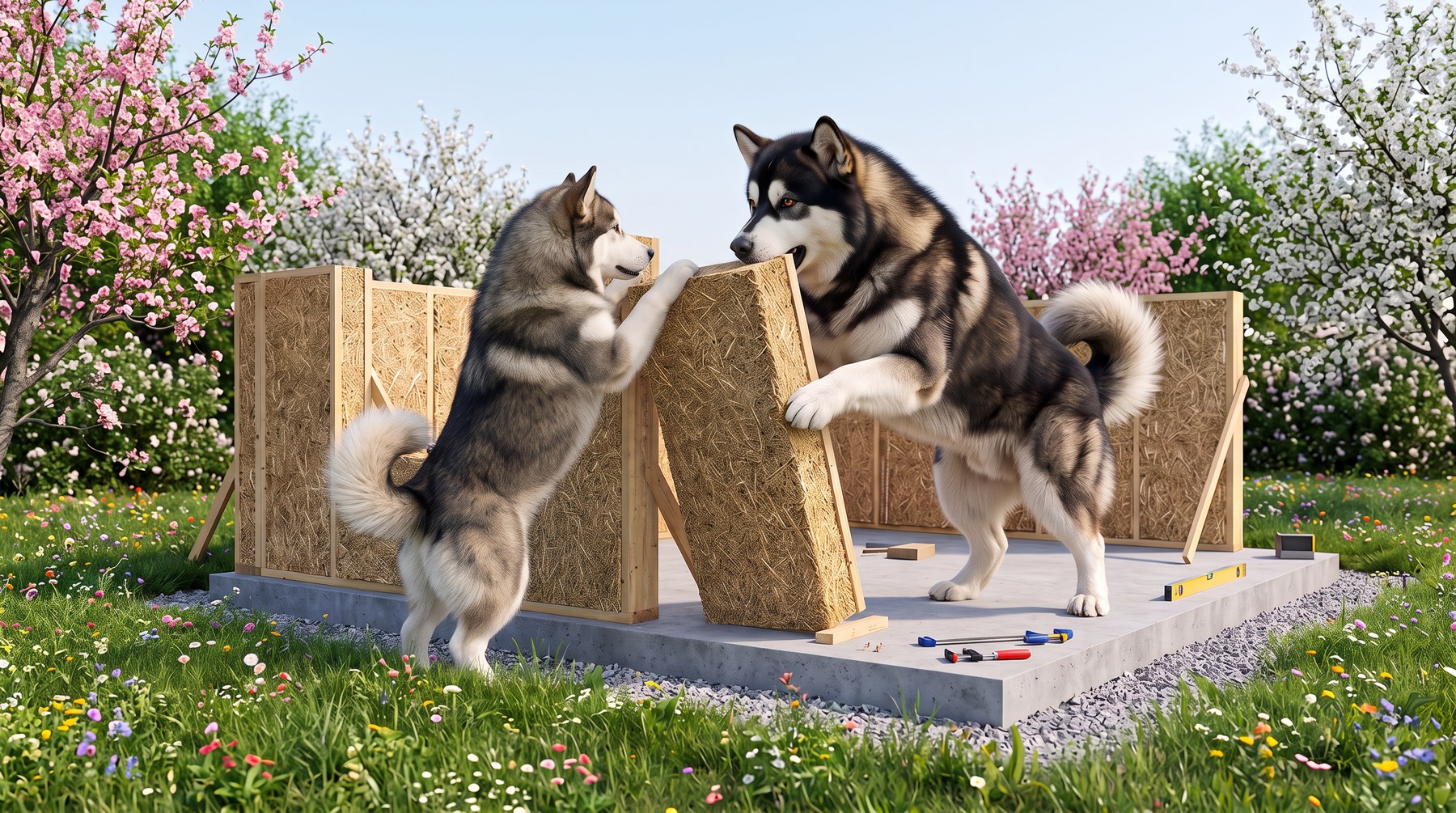
Two Alaskan Malamutes in a timber workshop easing a compressed straw panel upright
One — the panel Straw compressed into a structural board, in the workshop.
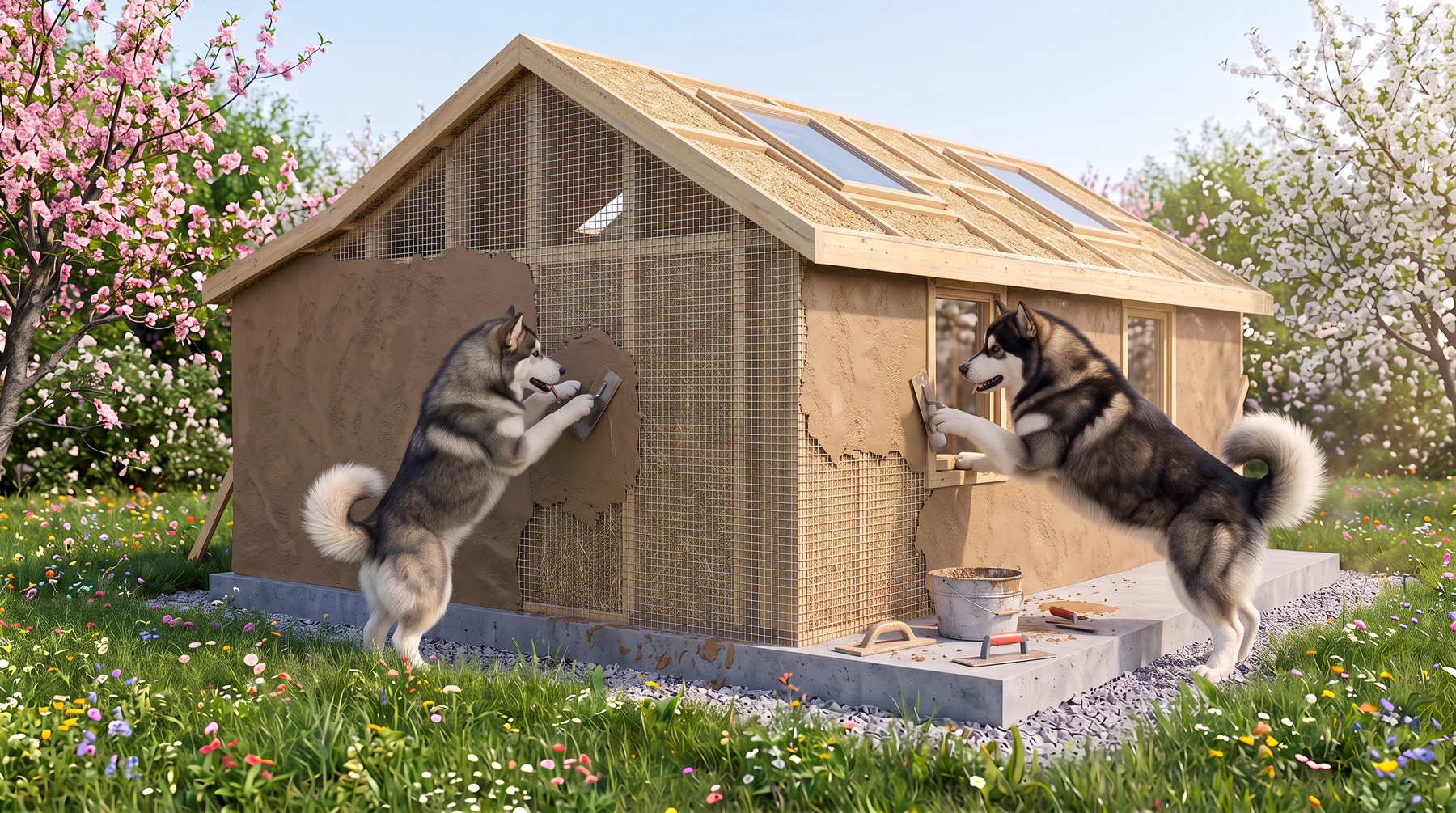
The two Malamutes raising straw wall panels on a concrete slab in a spring orchard
Two — the walls Panels going up on the slab, in an orchard in spring.
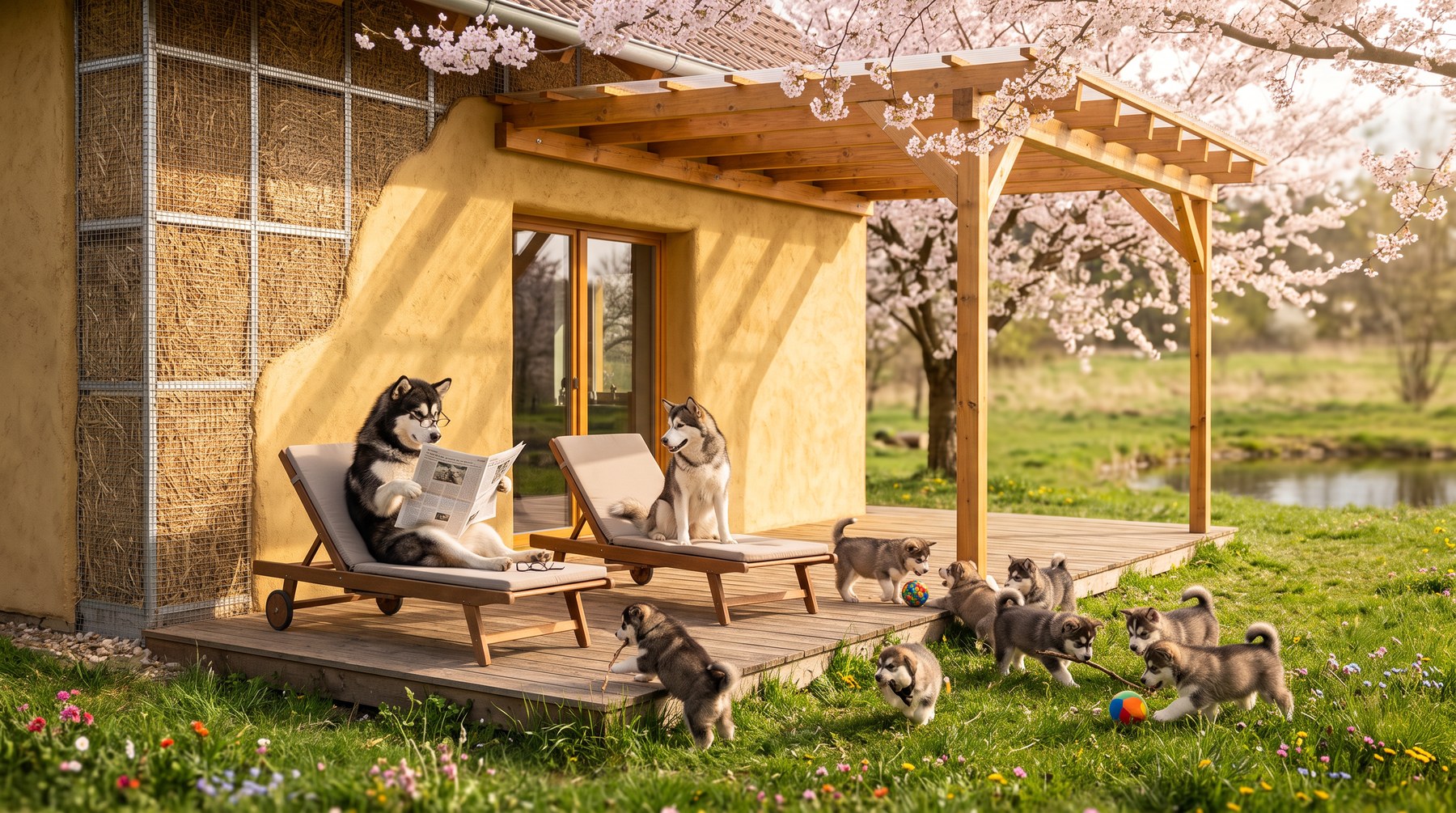
The two Malamutes applying lime render over the straw walls of the finished house
Three — the render Lime going on over the mesh, and the house is closed.

Togo and Alpha are real dogs. The build sequence above is illustration, not a delivered project — our actual completed work is in the portfolio.

Why a Malamute never gets shaved in summer.

A Malamute does not survive +40 °C because its coat is thick. It survives because the coat is dense. A woolly undercoat holds a layer of still air against the skin, and coarse guard hairs above it stop that air being carried away. Still air is a poor conductor of heat — that is the entire trick.

Which is why shaving one in summer harms it. The same trapped air that keeps the cold out keeps the heat out. The coat is not a heater and not a coolant; it is a barrier, and it works in both directions at once.

A straw panel does the same thing at building scale.

Straw is hollow-stemmed and fibrous. Compressed under heat and pressure it becomes a dense board holding millions of small pockets of still air, bound by the straw's own resins with no added glue — the 1935 Swedish process described above.

So one wall construction answers both a Macedonian January and a Macedonian August, for exactly the reason the coat does, and without a machine running to maintain it. Our declared figures: [U-value W/m²K] and [decrement delay, hours].

“We finally have the house of our dreams. Now we are enjoying life.”

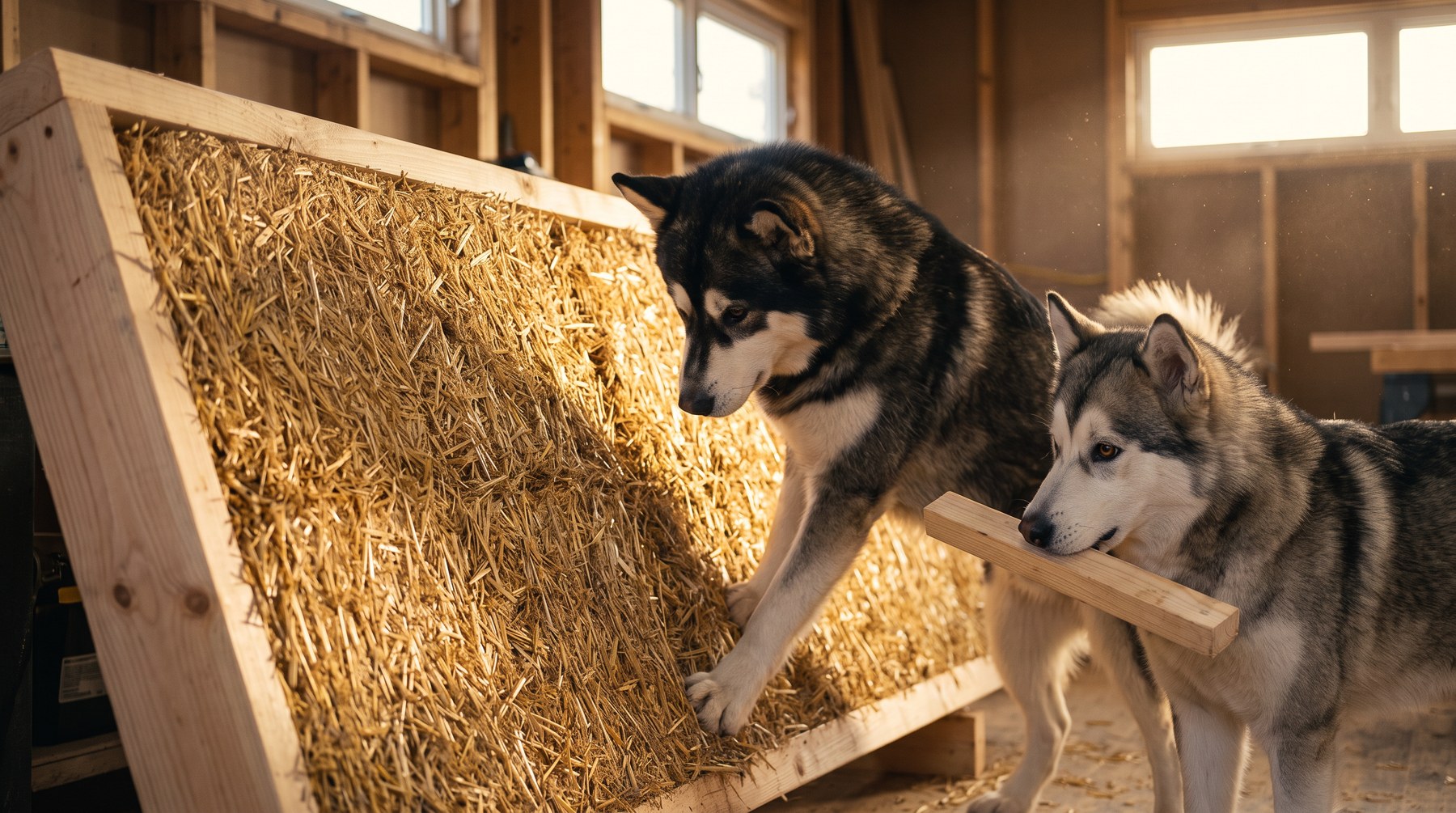
Togo reading on a lounger under the pergola of the finished straw house, Alpha beside him and puppies playing on the grass
Four — the house, finished and lived in. Rendered straw walls, a deep pergola for the August sun, and the next generation on the grass.

Two dogs bred for the Arctic came a long way to find a house built the way they are. They found it in Sosandra.

Community commitment

Building where we live.

Straw is a local material by definition — it is baled within a short drive of almost every site we build on. The commitments below say what that means in practice.

Local supply

Straw from nearby farms

Baled straw sourced within [radius] km of the factory, paid for as a crop rather than taken as waste — a second income on land that already grew the grain.

Training

Teaching the method

[what you run — apprenticeships, site days, trade training]. A build system nobody local knows how to assemble is not a build system.

Giving

Where our support goes

[causes and organisations you support].

Boards + affiliations

The bodies we answer to.

Straw-panel construction is assessed under the same regimes as any other structural system. These are the ones that govern our work — with our own certificate numbers shown as they are issued.

ISO 9001

Audited manufacturing

Accredited quality-management system, so every panel is produced to the same controlled standard. Certificate: [ISO 9001 no.].

ETA + CE

European Technical Assessment

The legal basis for selling and building with the panel across Europe, with third-party-verified declared performance. Our ETA: [ETA no.].

Passive House Institute

Certified component

Compressed-straw wall systems are among the few natural build systems to earn PHI component certification. Our status: [PHI cert / in progress].

EN 13501

Fire classification

European reaction-to-fire and REI resistance classification for the rendered assembly. Ours: [Euroclass / REI].

Eurocodes

Structural & seismic design

EN 1990–1998 including Eurocode 8 seismic design, plus the national anti-seismic and energy-performance codes for the country of construction.

Memberships

Trade bodies

[associations you belong to — e.g. national green building council, straw building network, builders' association].

See the full certification and test evidence →

Our environmental pledge

What the .eco domain obliges us to say.

Every .eco domain carries a public Eco Profile — a statement of environmental commitment the registry holds the owner to. Ours rests on three facts about the material rather than on intentions:

Stored carbon

≈115 kg CO₂ per m²

Straw takes carbon out of the air as it grows. Pressed into a wall and kept dry, it stays there for the life of the building instead of being burned or ploughed in.

Net-positive in use

A surplus, every year

Fabric first, then photovoltaics and storage sized so the house produces more than it consumes across the year — measured and reported, not assumed.

By-product, not crop

Nothing grown for us

Straw is what is left after the grain harvest. No land is farmed to supply us, and it is baled close to where we build.

Our published Eco Profile: [go.eco profile URL]. Verified figures for our own panels — λ, U-value, fire rating and EPD — are on the certifications page.

Begin your build

Tell us your plot. We'll tell you what it costs.

A written specification and an honest number — no pressure, no jargon.

Request a quote See the work →